
Is GEO dying?
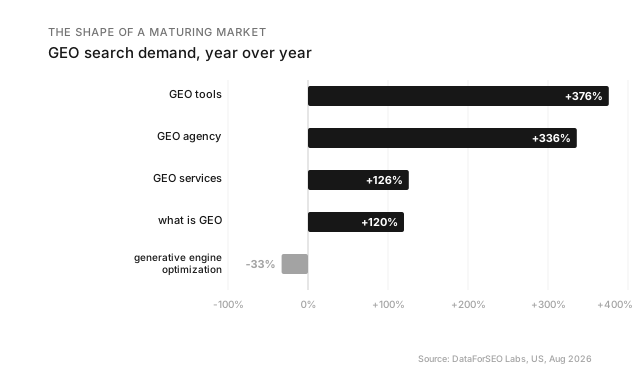
No, but the term peaked and the people searching it changed. Searches for generative engine optimization in the US now average 4,400 a month, down 33% year over year. The monthly series shows where the top was: 6,600 in August and September 2025, sliding through 4,400 in November, and holding at 3,600 for the last three months of the series.
If that were the only number, the obvious conclusion would be that a buzzword ran its course. It is not the only number, and the obvious conclusion is wrong.
What does the rest of the cluster say?
The opposite, and it says it loudly. Every query with a buying modifier attached is growing:
- generative engine optimization tools: 590 a month, +376%, difficulty 20
- generative engine optimization agency: 320 a month, +336%, CPC $45
- generative engine optimization services: 590 a month, +126%, CPC $40
- what is generative engine optimization: 880 a month, +120%
All figures DataForSEO Labs, US, English, August 2026.
There is also a name in the data that was not there a year ago. profound generative engine optimization does 390 searches a month. That is a vendor brand fused to a category term, and it is the single clearest sign in the whole table. Categories do not grow branded queries while they are dying. They grow branded queries when buyers have started shortlisting.
So the head term falls a third while services, tools, and agency demand roughly quadruple, and vendors begin to own search volume of their own. That is not decline. That is a different set of people arriving.
Isn't a falling head term just decline with extra steps?
It would be, if the head term had one audience. It has two, and they are moving in opposite directions.
An unmodified query like "generative engine optimization" is what you type when the phrase is unfamiliar and you want to know what it is, or when you have decided to follow the topic and you want the latest. The first group graduates. Once you know what GEO means you stop searching the bare term, because there is nothing left in it for you. The second group is small and stable.
That produces exactly the shape in the data. The bare term drains as the early cohort learns the answer and leaves. Meanwhile what is generative engine optimization, the explicitly definitional phrasing, grows 120%, which tells you a newer and less technical audience is arriving and asking plainly. And the modifier queries grow fastest of all, because the arriving audience has budget and a mandate rather than curiosity.
Early adopters stop asking. A wider audience starts asking. Buyers start shopping. All three at once.
When I first described GEO as a discipline in December 2024, the question was still whether this was a real practice or a rebranding. Twenty months later the search data has answered it in the least glamorous way available: people are paying for it.
Who is buying, and what are they actually buying?
Someone with a problem they cannot name and a budget line they can. The CPC range tells you their seniority.
Cost per click on generative engine optimization agency is $45. On services it is $40. On tools it is $37. Those are enterprise software prices, and nobody pays them to reach a practitioner reading up on a technique. They pay them to reach the person who was asked in a leadership meeting why the company does not appear in ChatGPT and left the room owning the answer.
That person is not buying optimization. They are buying three things in this order.
Evidence that there is a problem. Before anything can be fixed, the gap has to be shown to exist in a form that survives being questioned. This is why the measurement category exploded in parallel and why difficulty in that cluster runs as low as 5. Demand arrived before anyone wrote anything credible.
Someone to own it. The agency query growing 336% is a delegation signal. Most in-house teams do not have spare capacity, and GEO has arrived at precisely the moment when SEO headcount is under pressure. Buying it is easier than staffing it.
Permission to stop guessing. Underneath both is a request for a defensible position. Not "we improved", but "we did the thing a reasonable company does".
What happens to GEO as a separate discipline?
It gets absorbed, and the absorption has already started.
The pattern is well worn. A new surface appears, a specialist vocabulary forms around it, the vocabulary sells consulting for eighteen to thirty months, and then the large platforms ship the capability as a module and the specialism becomes a feature of the existing job. Mobile went that way. Structured data went that way. Core Web Vitals went that way, complete with a brief and lucrative period where "Core Web Vitals agency" was a viable business.
The tell here is the vendor brand query. When a category grows branded search, tooling is consolidating around a handful of names, and consolidation is the step before acquisition or absorption. The measurement side is further along: the incumbent suites have already shipped AI visibility modules and are collecting branded search volume for them.
I sketched several versions of where the SEO business goes by 2030. The version the data currently supports is the unexciting one: GEO does not replace SEO and does not survive as a separate profession. It becomes a workstream inside search, the way search everywhere optimization describes the broader shift, and the specialists who thrive are the ones who were already good at retrieval.
There is a window before that closes, and the window is what the agency and services numbers represent.
What does this mean if you are in-house?
Four things, and the first one is a warning about your own reporting.
Do not let the falling head term become an argument against the work. Somebody in your organization will find the 33% decline and present it as evidence that this was a fad. The counter is the same table: services up 126%, tools up 376%, agency up 336%, and a vendor brand doing 390 searches a month. Bring the whole cluster, not the headline.
Treat the incoming budget as temporary. If GEO work is currently funded as a distinct initiative, that funding exists because the topic is legible to leadership right now. When it gets absorbed into the search line, the initiative disappears whether or not the work does. Use the window to build things that survive the reorganization: measurement that keeps running, content that keeps earning citations, documentation that outlives the label.
Buy tools on method, not on category. The tooling query is growing 376% and the ranking difficulty is 20, which means the buying guides being published right now are thin. Ask any vendor how their prompt set is built and how many runs sit behind a number before you compare their score to anyone else's.
Do the boring half yourself. Most of what an agency will deliver in the first ninety days is retrieval hygiene: crawlable content, plain HTML for key facts, self-contained sections, original data. That is ordinary optimization work for AI search, and it is cheaper as a Tuesday than as a statement of work.
Where does this leave the term itself?
Somewhere less interesting than it was, which is the point.
The most useful reading of a 33% decline in a category's head term, set against quadrupling demand for its services, is that the argument phase ended. For two years the question was whether generative engine optimization was a discipline or a repackaging. That question generated a great deal of search volume and almost no purchase orders.
The question now is who does it and what it costs. That generates fewer searches and considerably more invoices.
Every discipline that matters goes through this. It stops being a debate and becomes a line item.
GEO just did.