Your impressions are up. Your clicks are down. And Google says everything is fine. It isn't fine. Ahrefs gave this phenomenon a name: The Great Decoupling, the moment when impressions and clicks stopped moving together. Understanding what's driving it, how to measure it, and what to do about it is what separates SEO professionals who adapt from those still waiting for traffic to come back.
What is actually happening in the SERP?
AI Overviews are answering the user's question before they ever reach your site. When Google serves an AI Overview, it generates a synthesized answer at the top of the page. The user reads it. Often, that's enough.
The AI Overview still triggers an impression for every page it cites, and sometimes for pages it doesn't cite but which rank organically beneath it. So your visibility metric goes up. Your click metric doesn't follow, because the user got what they needed without scrolling further.
BrightEdge documented this in May 2025: impressions grew +49% year over year since AI Overviews launched at scale, while CTR dropped 30%. Kevin Indig tracked the same divergence monthly in his Growth Memo, watching impressions climb 25% in July 2025, then 54% in August, while click volume stagnated.
If you plot this in GSC, you get what looks like a crocodile opening its mouth. Impressions form the upper jaw. Clicks form the lower. The gap between them is the AI tax you're currently paying.
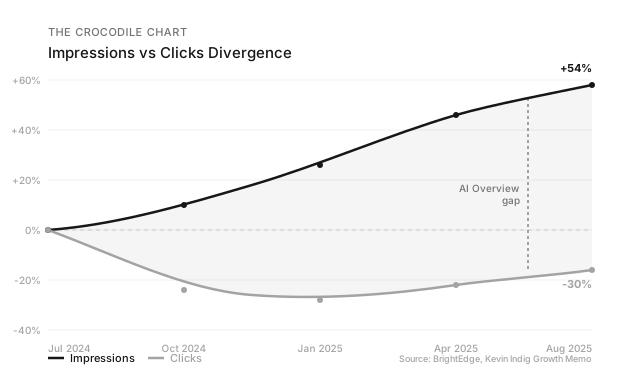
Ryan Law at Ahrefs confirmed it wasn't coincidence. For the Ahrefs blog itself, impressions and clicks had a positive correlation of +0.425 in the second half of 2024. By the first half of 2025, that correlation had inverted to -0.352. The divergence began exactly when AI Overviews expanded. Sites with almost no AI Overviews in their keyword sets showed no such pattern.
How big is the CTR drop?
At least ten independent studies have now documented the CTR collapse, and the direction is uniform. No study found a CTR increase. The debate is about magnitude, not direction.
Ahrefs ran the most cited analysis: 300,000 keywords, comparing March 2024 to March 2025. The first version found a 34.5% CTR drop at position 1 when an AI Overview was present. The February 2026 update, extending the window to December 2023 vs December 2025, found the drop had widened to -58%. CTR at position 1 fell from 0.073 to 0.016 on keywords that trigger AI Overviews. 99.2% of those keywords have informational intent.
Seer Interactive went deeper. Tracy McDonald analyzed 3,119 informational queries across 42 organizations: 25.1 million organic impressions, 1.1 million paid impressions. Organic CTR on queries with AI Overviews dropped 61% (from 1.76% to 0.61%). Paid CTR on the same queries dropped 68% (from 19.7% to 6.34%). One uncomfortable detail: queries without AI Overviews still dropped 41%, suggesting the behavioral shift goes beyond any single SERP feature.
Pew Research Center (July 2025) tracked real browsing behavior from 900 US adults across 68,879 unique queries. When an AI Overview appeared, users clicked traditional results only 8% of the time, versus 15% without one. Only 1% of users clicked links inside the AI Overview itself. 26% closed the session entirely after reading the AI answer, compared to 16% without one.
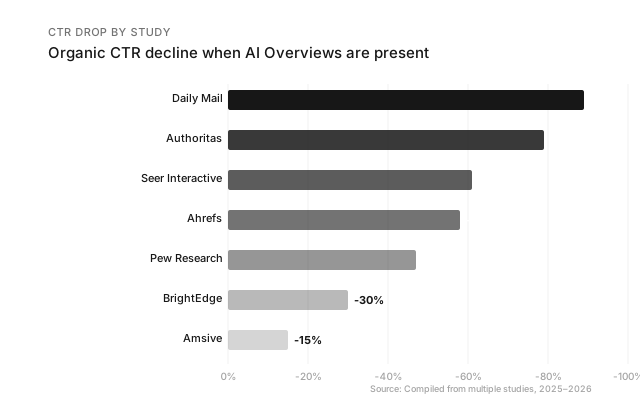
The range across studies is wide, and methodology matters. But the direction is consistent:
| Study | CTR Drop | Sample |
|---|---|---|
| Ahrefs (Feb 2026) | -58% position 1 | 300K keywords |
| Seer Interactive | -61% organic | 25.1M impressions, 42 orgs |
| Authoritas | -79% top organic | Multi-sector |
| Daily Mail (CMA data) | -89% desktop | Internal data |
| Pew Research Center | -47% (8% vs 15%) | 68,879 queries, 900 users |
| BrightEdge | -30% | High-volume keywords |
| Amsive | -15% avg, -37% with FS | 700K keywords, 10 sites |
Why is zero-click now the default?
Zero-click search has gone from a known pattern to the dominant one. Between May 2024 and May 2025, Similarweb measured zero-click searches rising from 56% to 69%, exactly the period when AI Overviews scaled globally.
SparkToro/Datos had already set the baseline in their 2024 study: only 374 clicks reach the open web for every 1,000 US Google searches. In the EU, it's 360. Semrush's State of Search Q1 2025 confirmed the direction: US organic click rate dropped from 44.2% (March 2024) to 40.3% (March 2025). Zero-click climbed from 24.4% to 27.2% in twelve months.
Bain & Company found that 80% of consumers use zero-click results at least 40% of the time. AI Overviews now appear in nearly 50% of all SERPs, up from 18.55% in Q3 2024 (Advanced Web Ranking). They reach 1.5 billion users monthly in 200+ countries. Coverage is no longer selective. It is the new default for informational queries. Google's growing tendency to monopolize searches with its own features only accelerates this pattern.
Which industries are getting hit hardest?
The impact is uneven. Some verticals are absorbing far more pressure than others, and the gap between most-exposed and least-exposed is dramatic.
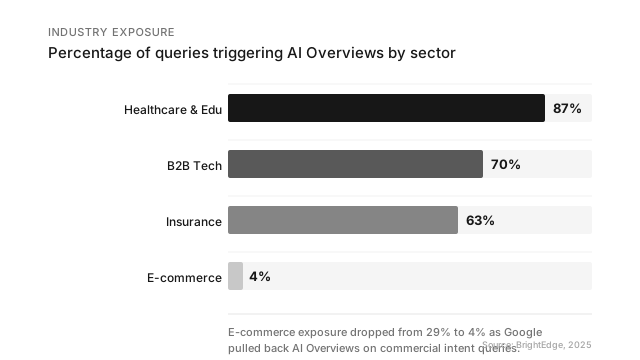
Healthcare and education are the most exposed: 87% of queries in those categories now trigger AI Overviews (BrightEdge). B2B tech follows at 70%. Insurance at 63%. E-commerce is relatively protected. Only 4% of queries generate AI Overviews, down from 29% earlier, as Google has been pulling back on commercial intent triggers.
The publisher sector is facing the sharpest operational consequences. Chartbeat tracked a 33% drop in Google-referred traffic to publishers globally between November 2024 and November 2025 (38% in the US alone).
Real cases from the field
- HubSpot went from approximately 13.5 million to 6–7 million monthly organic visits between November 2024 and January 2025. CEO Yamini Rangan named AI Overviews explicitly in an earnings call.
- Business Insider lost 55% of traffic between April 2022 and April 2025, resulting in a 21% headcount reduction.
- Forbes dropped 50%. CNN 27–38%. NBC News 42%.
- Stereogum, an indie music blog, lost 70% of ad revenue and pivoted to subscriptions.
- Chegg filed an antitrust lawsuit against Google in February 2025 after a 49% traffic drop. Penske Media Corporation (Rolling Stone, Billboard, Variety) followed with their own suit in September 2025.
Google's response, that total organic click volume has remained relatively stable year over year, hasn't held up against the publisher data. It's no surprise that users are turning away from AI search when trust in these answers is so fragile.
Do fewer clicks actually mean fewer conversions?
Here's the part most analysis misses: when someone does click through from an AI-influenced SERP, they arrive differently. They've already consumed the summary. They're not browsing. They're verifying, deepening, or transacting.
Ahrefs found that visits from AI search convert 23x better than traditional organic visits. Semrush documented a 4.4x higher conversion rate for AI-sourced traffic. Adobe Analytics tracked these visitors spending 41% more time on site, bouncing 23% less, and visiting 12% more pages.
The math changes when you factor this in. CXL ran the calculation: if you previously had 10,000 monthly visits at a 2% conversion rate (200 conversions), and AI search halves your traffic but brings your conversion rate to 8.8%, you end up with 220 conversions. Slightly more than before.
The click is pre-qualified. Zero-click search is compressing your funnel at the top, but the bottom is getting denser. This doesn't mean losing top-of-funnel traffic is fine. It means conversion rate should be your primary diagnostic, not total sessions.
Why do AI Overview citations matter so much?
Being cited in an AI Overview protects you from its worst effects. Not being cited amplifies them. Seer Interactive found in their November 2025 update that brands cited in AI Overviews got +35% organic CTR and +91% paid CTR compared to brands not cited.
How is citation distribution changing?
Ahrefs' July 2025 study found 76% of cited pages came from the top 10 organic results. By February 2026, that figure had fallen to 38%. Now, 31% of citations come from positions 11–100, and 31% from beyond position 100.
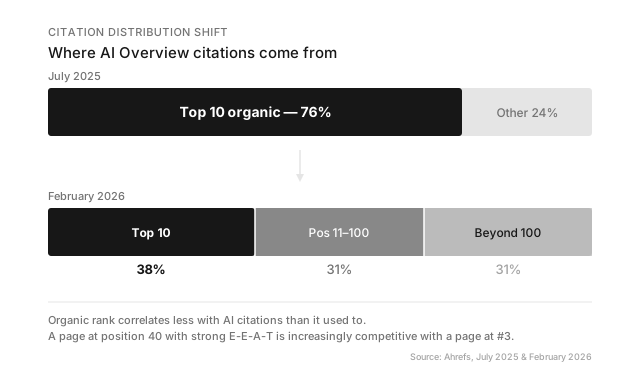
Your organic rank correlates less with AI citations than it used to. A page at position 40 with excellent structure, fresh data, and strong E-E-A-T signals is increasingly competitive with a page ranked #3. The two systems, organic ranking and AI citation, are diverging. This shift is part of a broader evolution of search with AI that is rewriting the rules of visibility.
Who gets cited most?
Profound analyzed 30 million citations and found Reddit at 21%, YouTube at 18.8%, Quora at 14.3%, and LinkedIn at 13%. Government domains get cited 3x more often in AI Overviews than in standard results (Pew, March 2025). YouTube is the most cited single domain in AI Overviews, with growth of 34% over six months.
Your citation strategy needs to go beyond your own domain. Community presence, video content, third-party reviews, and forum participation are now SEO surfaces. Understanding how Reddit factors into SEO is a good starting point for expanding your citation footprint.
How do you measure AI Overview impact in GSC?
Google Search Console doesn't separate AI Overview impressions from standard impressions. There's no filter. Danny Sullivan has confirmed there are no plans to add one. A screenshot claiming otherwise in September 2025 was flagged by John Mueller as fake. So you work around it.
Method 1: AI query regex filter
Apply this regex in GSC → Performance → Search Results → +New → Query → Custom (Regex):
(?i)^(who|what|where|when|why|how|which|is|are|can|does|should)|\b(vs|versus|compare|difference|pros and cons|guide|tutorial|best|top|list)\b
This isolates the query classes most likely to trigger AI Overviews. Compare CTR for this segment between your oldest available period and the last 90 days. A decline from 12% to 6% means you're giving up half your expected clicks on these queries.
Method 2: Third-party data merge
Export keywords that trigger AI Overviews from Semrush (Positions → SERP Features → AI Overview) or Ahrefs (Organic Keywords → SERP Features → AI Overview). Cross-reference against your GSC data for the same keywords across two time periods. Focus on queries where your rank held steady but CTR declined. Those are clean AI Overview impact signals.
Method 3: Branded vs non-branded benchmark
Google's AI-powered branded filter (launched November 2025) lets you separate branded from non-branded queries in GSC. Branded queries trigger AI Overviews only 4.9% of the time, versus 12–17% for non-branded (Seer Interactive). Branded CTR is your control group. If non-branded CTR declines while branded holds, you're measuring AI Overview impact directly.
What new KPIs should you track?
Traffic and CTR aren't disappearing from dashboards. But they're no longer sufficient on their own. Add these:
- AI Citation Rate: pages cited ÷ pages tracked, monitored via ZipTie, Otterly, or Semrush AI Visibility
- Brand search volume trend: GSC branded filter + Google Trends
- Direct traffic velocity in GA4: users who discover you via AI often return directly
- Revenue per visit and conversion rate by channel: the signal that matters most when volume shifts
- Competitor citation share: how often your brand appears vs competitors in AI responses on target queries
What can you actually do about it?
The playbook for surviving The Great Decoupling comes down to six concrete shifts. Each targets a different part of how AI systems decide what to cite and what to ignore.
Structure content for extraction, not just reading
The content formats that get cited share common properties: direct answers in the first 30% of the text (44.2% of all LLM citations come from the opening section), H2/H3 headers that map to questions, bullet points, comparison tables, and FAQ markup. Dense paragraph content performs worst in AI citation studies. Q&A structure performs best. For a deeper look at structuring pages for AI crawlers, see our guide on how to optimize your site for AI search.
Freshen your content systematically
Pages updated in the last 30 days are 3.2x more likely to be cited in AI Overviews. 85% of AI Overview citations were published in the last two years. 44% from 2025 alone (Seer Interactive). A systematic content refresh schedule, not just publishing new articles, is now a citation optimization tactic.
Build schema that goes beyond basics
Organization, Article, FAQ, HowTo, Person, and Product schemas increase AI citation probability by 28% (Search Engine Land). Pages with clean schema have a 2.8x higher citation rate (AirOps). This isn't technical SEO housekeeping. It's citation infrastructure.
Create content AI can't summarize adequately
Original research with proprietary data accounts for 50% of AI-sourced clicks despite representing only 5% of traditional organic clicks (WordStream). Interactive tools, calculators, configurators, and anything requiring user input cannot be replaced by a summary. These formats generate the clicks that survive the zero-click era. This is exactly the kind of helpful content that both Google and users reward.
Distribute beyond your domain
Reddit, YouTube, LinkedIn, and Quora are legitimate SEO surfaces now. A well-structured Reddit thread on a topic you own, a YouTube video with an optimized description, a LinkedIn post with original data. These aren't just brand awareness plays. They're citation candidates. The AI answers by pulling from the whole ecosystem. This multi-platform approach is at the heart of Search Everywhere Optimization.
Prioritize page speed for citation eligibility
Pages with a First Contentful Paint under 0.4 seconds get an average of 6.7 AI citations. Pages above that threshold get 2.1. The fastest pages are 3x more likely to be cited (Growth Memo, March 2025). Core Web Vitals connect directly to AI visibility.
Where does The Great Decoupling go from here?
AI Overviews were in 18.55% of SERPs in Q3 2024 and 49.92% in Q4 2025. They reach 1.5 billion users. This trend doesn't reverse. Meanwhile, ChatGPT's growing search share adds another layer of pressure on traditional click-through behavior.
What changes is how you measure the value of search visibility. An impression that reaches a user who reads an AI-generated answer and absorbs your brand's name as the cited source isn't wasted. It's brand conditioning without the click. The user forms an association, your domain as the authoritative source on this topic, that influences their behavior the next time they have intent.
The citation in an AI Overview is becoming the new position 1. It doesn't guarantee the click, but it determines who gets it when the user decides to go deeper. SEO professionals who understand this are already building for it: tracking citation share rather than rank, measuring conversion rate by channel rather than total sessions, and treating Reddit, YouTube, and LinkedIn as seriously as their own domain. The shift from optimizing pages to training search engines is already well underway.
The ones waiting for the impressions-to-clicks ratio to normalize are going to be waiting a long time.