Agentic commerce is here. In January 2026, Google and OpenAI each formalized how AI agents will buy things on behalf of users.
Google calls theirs Universal Commerce Protocol. OpenAI built the Agentic Commerce Protocol with Stripe. Both work the same way: you describe what you want, the agent researches options, shows you the best match, and completes the purchase. You approve. Done. No product pages. No cart. No checkout flow.
This isn't about discovery anymore. AI Overviews and AI Mode already changed how people find products. These protocols change how people buy them.
Two ecosystems. Two standards. The question for merchants: which one do you build for?
What Google Announced at NRF 2026
At the National Retail Federation conference, Sundar Pichai laid out Google's approach.
UCP is open-source. Shopify, Walmart, Target, Etsy, and Wayfair helped build it. Another 20+ partners signed on, including Adyen, Visa, Mastercard, and Stripe.
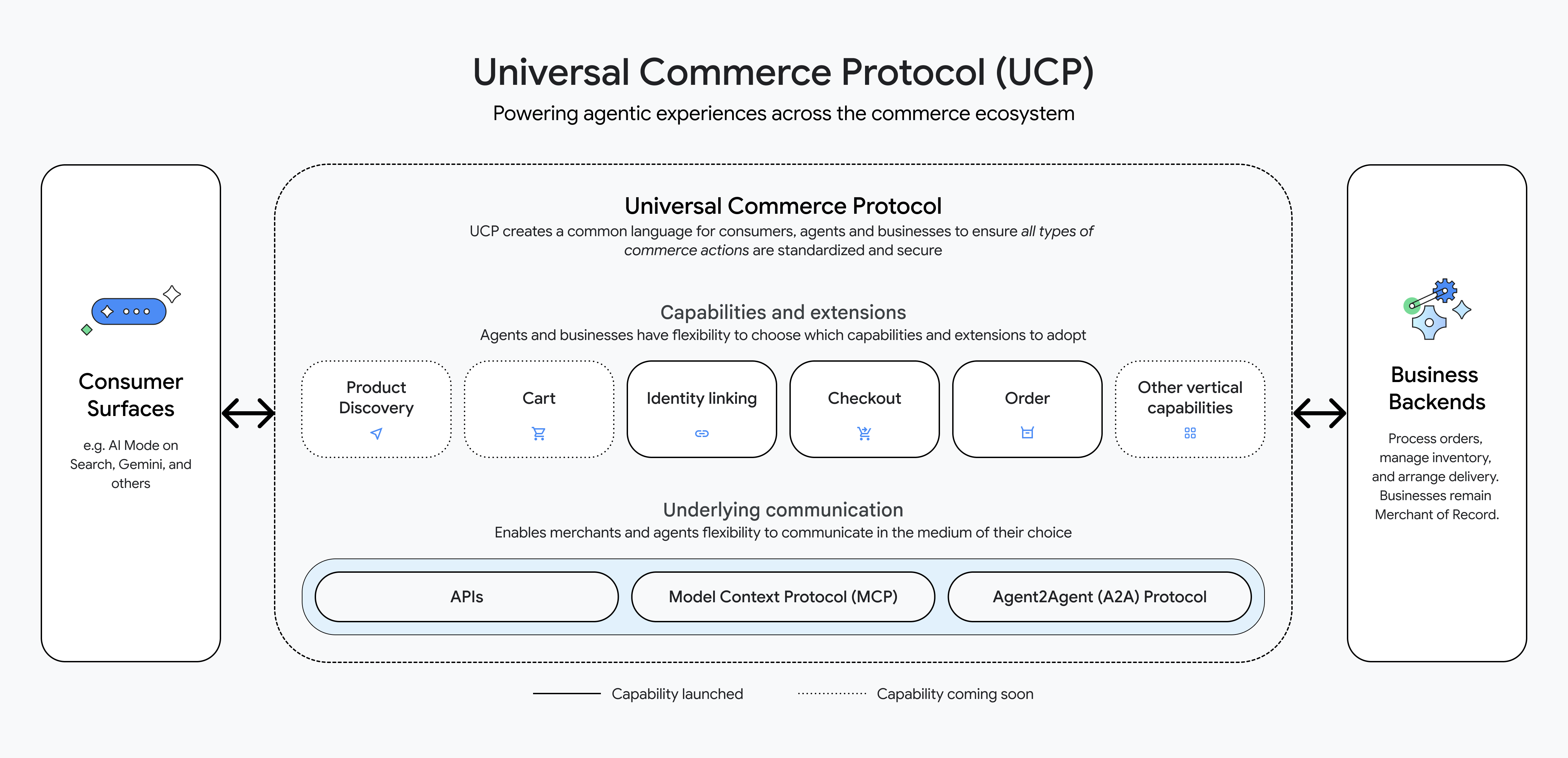
The buy button now sits inside AI Mode and Gemini. When you search, the agent can apply personalized offers, enroll you in loyalty programs, suggest upsells based on your history, and complete payment through Google Pay. You never leave the conversation.
Google also launched Gemini Enterprise for Customer Experience. Kroger, Lowe's, Papa John's, and Home Depot are already using it. The platform combines shopping and customer service into one agent layer.
The scale matters. Google's Shopping Graph holds over 50 billion product listings. It updates 2 billion times per hour. Google Cloud processed 90+ trillion tokens for retail customers in December 2025. That's up from 8.3 trillion the year before. An 11x increase in one year.
OpenAI's Parallel Move
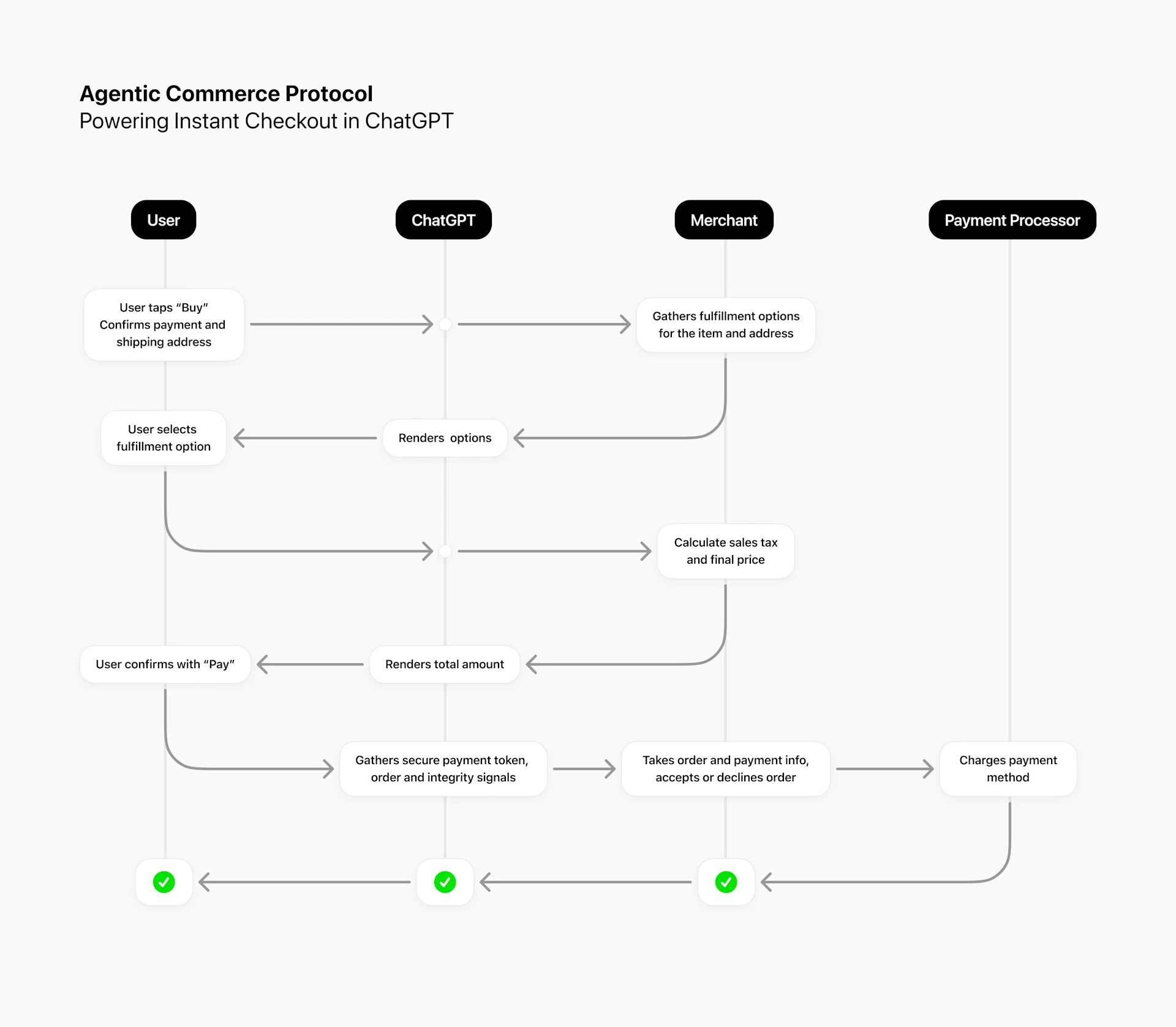
OpenAI isn't standing still. The Agentic Commerce Protocol powers checkout directly inside ChatGPT.
Operator, their autonomous agent, launched in January 2025. It navigates websites, clicks buttons, fills forms, and completes purchases. eBay, Etsy, and Instacart have partnered with it.
Instacart was first to offer full checkout inside ChatGPT. You go from meal planning to a delivered grocery order without leaving the chat.
Since September 2025, OpenAI has announced deals with Target, DoorDash, and Walmart. The pattern is consistent: embed transactions inside the conversational interface.
About 2% of ChatGPT queries involve shopping. With 700 million weekly users, that's roughly 50 million shopping queries every day. Even a small conversion rate represents serious volume.
Google puts commerce inside search. OpenAI puts commerce inside chat. Both want to own the transaction layer between intent and fulfillment.
Why Amazon Is Playing Defense
Amazon blocked external AI agents from accessing its site. The move protects its $56 billion advertising business, which depends on people browsing Amazon's interface.
In late 2025, Amazon sued Perplexity for allegedly scraping its site. The lawsuit shows what's at stake: if AI agents can transact across retailers without users visiting those sites, owned traffic loses value.
Amazon isn't absent from the race though. Its "Buy For Me" feature lets you shop other brands' websites without leaving the Amazon app. Amazon becomes the agent layer, not the destination.
CEO Andy Jassy acknowledged the problem in October 2025. Most AI shopping agents give generic recommendations with wrong prices and delivery estimates. "We've got to find a way to make the customer experience better," he told analysts.
That's the opening. Whoever solves personalization, accuracy, and trust captures the transaction layer. No one has won yet.
SEO Implications: From Keywords to Context
For SEO professionals, agentic commerce creates a structural problem. Product catalogs were built for keyword search. They don't work for conversational AI reasoning.
Consider the difference:
| Traditional Query | Agentic Query |
|---|---|
| running shoes men size 10 | I need running shoes for a marathon in April, I overpronate, prefer minimal drop, budget under $150, and I've had good experiences with Brooks |
The second query includes occasion, biomechanics, technical preferences, budget, and brand history. Standard product feeds can't handle this.
Scot Wingo, founder of ReFiBuy, puts it well: GenAI knows more about the shopper than Google ever did. Your job now is to expand and contextualize the product catalog so the engine can match shopper context to the right SKU.
What you need to do:
Go deeper with structured data. Basic Schema.org isn't enough. Product feeds need granular attributes: fit, durability, use cases, compatibility, and contextual recommendations.
Keep inventory current. Google's Shopping Graph updates billions of times per hour. Agents will skip products with stale availability data.
Enrich your reviews. Agents parse reviews for patterns. Recurring complaints, standout features, sentiment trends. If you don't build your own review-enrichment pipeline, you leave interpretation to the models.
Create conversational content. FAQ pages, comparison guides, and long-form product narratives become training data for agent reasoning. Content that answers "why this product for this person in this context" will get cited.
This isn't incremental optimization. It requires rethinking product information architecture from scratch.
Who Controls the Infrastructure
McKinsey estimates agentic commerce could redirect $3-5 trillion in global retail spend by 2030. Nearly $1 trillion from the U.S. alone.
Mobile commerce didn't just add a channel. It restructured discovery, UX, and payment. Agentic commerce will do the same for the transaction layer.
Juan Pellerano-Rendón, CMO of Swap, calls the current moment "pre-Sputnik." Everyone is building the spaceship. No one has really launched it yet.
Julie Bornstein, founder of AI shopping platform Daydream, agrees. Perfecting these experiences will take longer than anyone thinks. 2026 is a step along the way, not the finish line.
For SEO and e-commerce professionals, the priorities are clear:
Watch both ecosystems. UCP and ACP will coexist for now. You need visibility into how products surface across Google AI Mode, Gemini, ChatGPT, and Operator.
Audit product data for agent readability. The gap between keyword-optimized catalogs and context-rich feeds is where competitive advantage lives.
Track new metrics. Citation share in agent responses, conversion from agentic traffic, and assisted transactions will matter more than raw organic clicks.
Build flexibility. Create modular content systems that feed LLMs, structured data that serves multiple protocols, and measurement frameworks that can pivot.
The 2026 protocol wars aren't about which company wins. They're about which standard becomes the default rails for AI-mediated commerce. The merchants and practitioners who understand this will shape what checkout means for the next decade.